
Ground autonomy is being procured faster than it is being tested in public.
Programmes are moving to orders while the observable record of trials stays thin, unrepeatable or classified. A gap is not a finding, in either direction.
Executive summary
Several programmes have moved from prototypes to production orders while the public record of trials remains summary-level. The right reading is neither that the systems work nor that they do not: it is that the evidence needed to judge them is not in the public domain, and that this is itself a finding about how the capability is being bought.
The development
Ground autonomy has followed a procurement pattern familiar from earlier defence cycles. A prototype is shown in an exercise, a requirement is written around what was shown, and an order follows before an independent trial record exists. The public documents are the award notice, the requirement and, occasionally, a summary test report.
In the current cycle the pattern has accelerated because the platforms are software-heavy. Software can be updated after delivery, so an order can be justified as a decision to buy a development path rather than a finished system. That is a defensible commercial structure. It is not a capability finding, and it is routinely reported as one.
Technology and capability
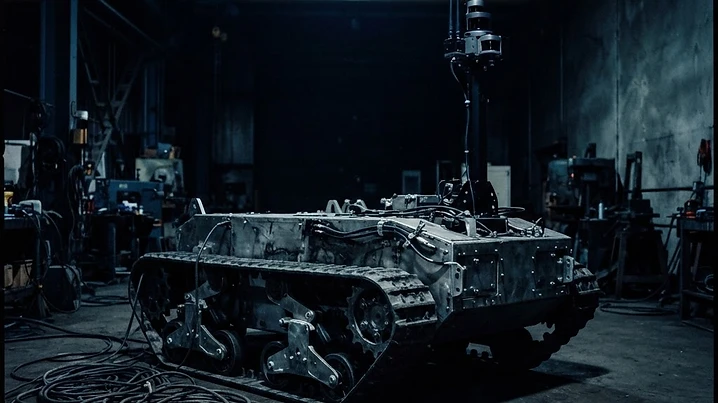
The platforms combine a mobility chassis, a sensor suite and a autonomy stack that fuses lidar, radar, electro-optical imagery and inertial data. The stack is where the claims concentrate: route following is largely solved on prepared ground, while classification of what is in front of the vehicle, and the decision to stop or proceed, is where the failure modes sit.
The dependencies that decide performance are positioning and communications. Satellite navigation can be degraded or denied; a datalink can be jammed. A platform that requires either to be safe is a platform whose performance is conditional on an environment the buyer does not control.
What has been demonstrated
Prototypes have participated in named exercises, and some programmes have published summary statements that a system met a requirement in a defined scenario. Those statements are evidence that a trial occurred and concluded. They are not evidence of the reliability, the intervention rate or the performance envelope behind the conclusion.
What is claimed, not demonstrated
Developers and programme offices describe operationally relevant autonomy, reduced manpower per platform and rapid software iteration. Each is plausible and none is publicly measured. The claim that is most often repeated — that autonomy reduces the number of people needed — is also the claim least often quantified, because it depends on the maintenance and recovery burden per platform, which is not disclosed.
Capability, as evidenced
Supervised autonomous movement over prepared routes
Reported testingTrials are reported by the buyer or the developer. Conditions, duration and failure modes are not published.
Autonomous navigation in contested or denied environments
ResearchAsserted as the purpose of current programmes. No public test record establishes performance under jamming or degraded positioning.
Human-machine teaming with a dismounted section
PrototypePrototypes are reported in exercises; the reports describe participation, not measured effect.
The organizations involved
Defence procurement agencies
BuyerAward notices are public; the trials behind an award usually are not.
Ground autonomy developers
Platform developerNamed in award notices and in their own announcements.
Test and evaluation establishments
AssessorSome publish summary findings; most publish conclusions without data.
Why it matters · Lawton reading
The consequential question is not whether a vehicle can drive a route. It is whether the formation that receives it needs fewer people, more people, or the same people with different skills. That question is answered by maintenance data, and maintenance data is not in the public domain.
A second consequence is structural. If capability is bought on a development path, the buyer carries the integration risk, and the cost of a programme becomes visible only after several software cycles. That should be stated in the record, and it usually is not.
Economic consequences
Procurement at this stage favours suppliers with a software organisation and a production line, because the buyer is purchasing both. It also creates a durable position: a platform bought in a first tranche is the platform the next requirement is written against.
For suppliers outside the programme, the commercial opening is not the platform but the components that constrain it — positioning systems that do not rely on satellite navigation, secure datalinks, and test instrumentation that can produce the reliability data buyers will eventually require.
Limitations and uncertainties
- Most trial data is classified, so the assessment rests on award notices and summary statements.
- Summary findings published by test establishments describe conclusions without the data behind them.
- The desk cannot observe trials and does not infer performance from procurement volume.
What to watch next
- 01A published test report that includes failure modes rather than a conclusion.
- 02Disclosure of maintenance burden per platform, the figure that decides the manpower claim.
- 03A trial record under degraded positioning or communications.
- 04A second buyer's decision, which tests whether the first award was a capability choice or a supply-base choice.
Sources · 3
- Original
Award and contract notices
Public procurement records (US and allied) · 2025-2026
That orders were placed, with values and quantities; not that capability was demonstrated.
- Original
Programme statements and exercise releases
US Department of Defense · 2025-2026
Participation in exercises and summary conclusions.
Company announcements on autonomy programmes
Developer releases · 2025-2026
The developers' own description of the platforms.