Surfaces marked Professional open with a membership — seven days free, then $99 a month. See what it opens.
"Mapping global systems, markets, cities, supply chains, and organizations."
Global Headquarters · Washington, DC
Lawton Institute for Global Systems Intelligence
Lawton View
Beyond the Headlines. Into the Forces Shaping the World.
The most important developments are not always the most visible. Behind every major market movement, corporate decision, government policy, technological breakthrough, and shift in global investment are forces that influence what happens next.
Lawton View examines those forces. Through independent research, global intelligence, historical perspective, and evidence-led analysis, we connect developments across markets, institutions, industries, capital, technology, and cities.
We look beyond what happened to examine why it happened, what is changing, who is positioned to benefit, where risks are emerging, and what decision-makers should be watching.
Our purpose is to make the complex understandable, the overlooked visible, and the consequential worthy of attention.
The movements of capital, trade, economic power, investment, and industrial transformation shaping the global economy.
For Institutions
See the Forces Shaping Tomorrow. Understand What They Mean Today.
The world's most consequential decisions are made before the outcome is obvious. Capital moves. Industries change. Companies reposition. Technologies emerge. Governments set new priorities. Cities compete for investment, talent, and economic influence.
Yet the information needed to understand these developments is often fragmented across institutions, markets, industries, and borders. Lawton Intelligence exists to connect that information, examine what others may overlook, and help decision-makers see the larger picture.
What that means when you sign: the same evidence standard whether the question is a market entry, a counterparty, or a plan a government has published — so four very different answers stay comparable.
Intelligence for Those Who Shape Markets, Institutions, and Economies.
Through GIAI — Global Intelligence AI, Lawton develops an integrated view of the forces shaping the global economy and the institutions operating within it. We examine how capital is deployed, how businesses create and protect value, how industries evolve, where competitive advantage emerges, and how public decisions influence economic outcomes.
We go beyond reporting what happened. We investigate why it happened, what conditions made it possible, what may follow, and which assumptions deserve to be challenged.
Five Questions That Matter
Understand capital flows, emerging markets, industry transitions, investment activity, and changing economic advantages.
Multiple Perspectives
One Intelligence Foundation. Multiple Perspectives.
For corporate leaders, a broader understanding of markets, competition, capital, strategic opportunity, and enterprise risk. For institutional investors, a way to examine economic developments, industry transformation, capital allocation, and emerging investment conditions. For mayors, governors, and economic-development leaders, the connection between investment opportunity, corporate expansion, infrastructure, workforce, public priorities, and regional competitiveness.
Diplomatic Missions
Institutional intelligence for missions navigating complex political, economic, technological and regional systems.
Different responsibilities. Different decisions. A shared need to understand how the world is changing. The representation changes with the decision context; the evidence standards, analytical discipline and revision process do not.
Beyond Information. Toward Better Judgment.
Information tells us what is known. Intelligence examines what it means. Lawton combines global research, historical evidence, institutional analysis, geographic intelligence, and AI-supported reasoning to develop a more complete understanding of complex systems.
Our work is designed to make assumptions visible, distinguish evidence from interpretation, compare possible outcomes, and continuously revise assessments as conditions change.
We do not treat a forecast as a fact, a possibility as an opportunity, or an unanswered question as a conclusion.
The objective is not to produce more information. It is to improve the quality of understanding behind consequential decisions.
The World Is Connected. Your Intelligence Should Be Too.
Options are built from the records on file. A filter that offers nothing is a register that holds no such record, not a register that holds no activity.
Continental United States · equirectangular reference grid
1 plotted · 441 not yet plotted
Covered markets
442
Published developments
14
Business news and developments
80
Verified developments and published observations, most recent first. The activity and period controls describe the deal register.
CITY · West Africa
Abidjan, Cote d'Ivoire
The metropolitan economy defined around Abidjan, in Cote d'Ivoire.
Lawton holds the national reading for the country this market sits in: the World Bank's published series for that country, each figure carrying its own reference year. It is national context. No city-level series is held for this market, so nothing here is a measure of the city.
No published development is linked to this market. This is separate from the economic figures above.
What this record does not establish
The administrative areas the market is defined by have not yet been recorded on this record, so sources published below national level cannot yet be attributed to it.
A verified relationship is one the evidence establishes. An analytical reading is a link the record itself marks as inferred or unresolved. A potential is something announced or anticipated rather than done.
Lawton View · Visual Stories
The reading behind the development.
How the arrangement works, what changes if the reading holds, and what would settle it.
Lawton translates an observed development into an opportunity worth investigating — and states plainly whether the evidence establishes it, whether it is conditional, or whether it is still a hypothesis.
If you are deciding this quarter
Open the one whose market you already hold. Its evidence chain tells you whether the signal is yours to act on, or someone else's to sell you.
Lawton Intelligence · Institutional Intelligence for Complex Systems
See OpportunitiesBefore Everyone Else.
The tender behind the plant your supplier is pricing was published in March. So was the subsidiary exhibit that shows who actually owns your counterparty. Lawton reads those records as they are filed and states where the evidence stops — so what you take to the board is something you can defend.
Observe systems. Expand the analytical space. Challenge assumptions. Examine scenarios. Revise with evidence.
The most expensive decisions are made before the record reaches the board.
Not because the evidence does not exist. Because it is published as a filing, a tender, a gazetteer entry or a subsidiary exhibit — months before it becomes a line in a deck. Lawton shortens that distance, and states where the evidence stops.
The memo you will have to write
You will be asked why this market and not the other. This is the page you answer with: the record, the date it was published, and the boundary stated before anyone asks.
01
Where to commit capital next, and in what order.
What it costs
A market entered one cycle late is paid for twice: once in the price already moved, and again in the years spent unwinding a position taken on a reading nobody checked.
What you receive
A market reading with its evidence attached: what the source published, the period it covers, the geography it states and what the record does not establish.
Ownership, parentage and control taken from an announcement rather than a filing become a warranty in a signed document, and the exposure outlives the deal team that wrote it.
What you receive
A transaction brief: parties, stage, consideration, the ownership chain behind them, and the evidence standing of each claim — separated from the Institute's reading.
Every route below opens a request. Scope and terms are agreed with the institution after review, and no request implies acceptance, engagement or a fee.
A chief executive and a city executive wake up asking different questions about the same world. One is deciding where to commit capital; the other, where investment will choose to land. Lawton answers both from one connected record of what sources published.
01
The answer
What the evidence currently indicates, stated as a position with the boundary of what it does not establish.
02
The mechanism
How the conclusion was reached: the sources, the assumptions, and the indicator that would reverse it.
03
The artifact
The brief, register, scorecard or decision map — something that can be assigned, acted on and measured.
01
The Chief Executive
Where the market moves, what it opens, and what to decide.
For corporate leaders, investors and institutional decision-makers.
A company announcing a new manufacturing facility is a single published event. Held once, it answers both agendas — without seven records that disagree about what happened.
A corporate expansion signal
A competitor movement alert
A supplier opportunity
A city investment prospect
A workforce demand requirement
An infrastructure planning requirement
A procurement opportunity
The operating rhythm
Daily
Material developments, and the urgent opportunity or risk they carry.
Weekly
Market movement, competitor action and city investment intelligence.
Monthly
Opportunity reviews, business barriers, capital in motion.
Quarterly
Market position, city competitiveness, the standing scorecard.
The quality standard
Every assessment separates what is established from what is not. An unresolved reading is printed as unresolved, never as a zero.
Verified
Partial
Unknown
Not covered
Conflict
What is being sold
Not ten dashboards. Two executive intelligence services on one foundation: corporate intelligence, and municipal intelligence. The shared record is the advantage — a company can find the city that fits its requirements, and a city can find the company it should pursue, in the same evidence.
A U.S.–Japan initiative places foreign capital, domestic manufacturing and a public equity position into one arrangement. The terms of each are still to be established.
Why it matters economically
The public support and the public ownership are separate arrangements. That distinction is what determines whether the state ends up funding capacity, holding a position in it, or both.
Stage
Announced
Headline figure
$21.00bn
Total programme value stated for the two proposed facilities. It is not United States public expenditure, it is not private capital, and it is not money that has moved.
Whether to structure an economic-development agreement to take a position in the value the arrangement creates, rather than to provide support without equivalent participation in the upside.
Clients with exposure to GlobalFoundriesawaiting evidence
Whether the reported equity position and the project structure change the reading of the company's capital position and of its stated capacity commitments.
Whether to treat this arrangement as evidence of a transferable model in which public support is converted into a financial position, or as a case with specific features that do not generalize.
A deal is announced in a jurisdiction, built on a site and staffed from a labour market. Lawton assembles the market record behind that place — its economy, its industries, its institutions and the evidence behind every figure.
A market appears once its record is established and its evidence assembled. Inclusion records that a market is within Lawton's coverage, never that it is among the best places to invest.
A market you are actually deciding
Name the three cities you are choosing between and we will state what the register holds for each — and what it does not hold.
GAIA SDARI reads global military AI, robotics and autonomous systems from the evidence outward — what was tested, by whom, on what public funding, and what it carries into compute, energy, manufacturing and procurement.
Permanent doctrine
A press release, a procurement announcement, a prototype demonstration, a test report and a verified operational deployment are five different evidence classes. They are never treated as equivalent, and a summary never replaces the source record behind it.
Why this reaches a balance sheet
Every layer described here is somewhere your supply, your systems or your assumptions can fail — and somewhere a competitor is reading the same record you are.
Four domains, classified once, so a programme in one country can be read against another's instead of compared by the loudness of its announcement.
01
Artificial intelligence
Model families, computer vision, information fusion, edge inference, simulation and AI assurance — each held with its developer, sponsor and maturity.
02
Robotics
Ground, aerial, maritime, space and industrial systems, tracked by manufacturer, application and what has actually been shown to work.
03
Autonomy & human-machine teaming
Supervised autonomy, multi-system coordination, perception and environmental adaptation, with the control and communications dependencies that bound them.
04
Supporting infrastructure
Semiconductors, accelerators, compute, sensors, power and manufacturing capacity — assessed apart from the software that runs on them.
Seven layers
One observation layer, five readings, one register of what it opens.
01
Global observation
Publicly available sources, each held with its own date, scope and classification.
02
Evidence & source intelligence
Quality, corroboration, conflict and recency — read, never assumed.
03
Entity & relationship
Sponsors, parents, suppliers and partners, held with the history of when each applied.
04
Capability
One structured record per system, so capabilities can be compared across countries.
05
Strategic assessment
Progression, maturity, dependency and the alternatives that would explain the same facts.
06
Economic consequence
What the development changes downstream in compute, energy, industry and procurement.
07
Opportunity intelligence
Lawful commercial openings only — published programmes, capacity, services, modernisation.
Maturity, as evidenced
A capability is placed at the highest stage its record establishes.
01
Concept
Proposed or described, and nothing further.
02
Research
Active work is publicly documented.
03
Prototype
A prototype is reported, which is not a test.
04
Reported testing
A trial is reported, which is not a deployment.
05
Reported deployment
Use is reported; independent verification is recorded separately.
Verification is its own field, never inferred from a stage. A programme that has been announced for eight years is not advanced; it is repeatedly announced.
Lawton does not produce weapon-employment plans, tactical targeting recommendations or operational instruction. The register reads capability, capacity and consequence, and stops there.
Global Systems Intelligence
The world as a single causal graph.
Lawton models the global economy as one connected structure — a causal graph of nodes, corridors, and institutions through which shocks travel. We do not forecast isolated variables. We simulate how a single event propagates through the entire fabric.
Causal Graph
The world rendered as connected causality.
Corridor Intelligence
Continuous monitoring of strategic passages.
Shock Propagation
How disruption cascades across borders.
Simulation Fabric
Millions of scenarios against a living model.
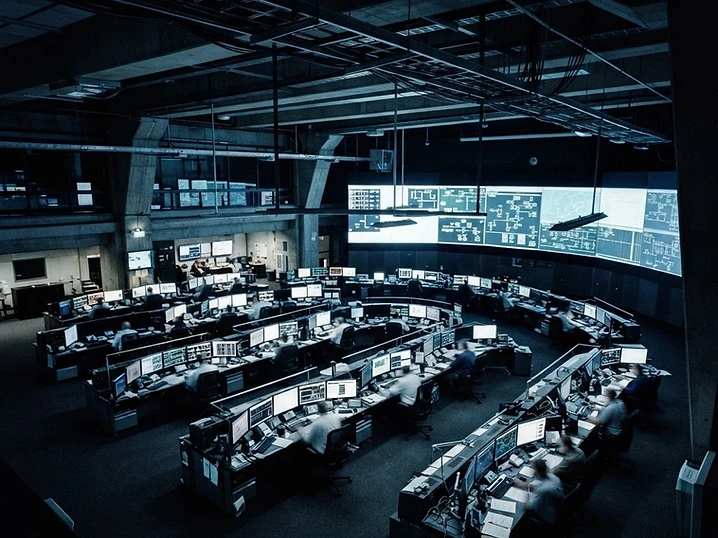
Operations floor, global systems model.
Systems Intelligence Directorate
Global Intelligence Insights from Lawton Institute
The Systems Intelligence Directorate issues strategic releases, global systems briefings, corridor intelligence updates, sovereign systems reports, supply chain stress tests, and organizational intelligence diagnostics. These insights power the Global Editorial section and the Systems Intelligence Directorate Grid.
The Systems Intelligence Directorate maintains a structured reading of 76 peer institutions. Each is tracked by a dedicated monitoring agent that records what the institution covers, where its published remit stops, and what sits outside it. The grid is a map of remits, not a ranking.
Policy & GovernanceDefense & SecurityDiplomacy & Sovereign SystemsEconomics & MarketsSupply Chains & CorridorsSocial & Normative Systems
Each node represents a global think tank and its dedicated Lawton AI agent within the Systems Intelligence Directorate. Institutions are catalogued from publicly available information. Comparisons describe remit and method, never quality, and no ranking is implied.
Where the systems layer sits
Each profile describes a peer's remit and where that remit stops. The comparison is an analytical complement, not a ranking: it states where the remit sits relative to the Institute's own, not which institution is better. The method behind it, and its limits, are published in full.
Select a think tank node to view its analytical profile, comparison article, image, and the Lawton Systems Interpretation.
What Lawton currently believes — and what would change it.
Assessed October 2026
01
Corridor disruption arrives as a schedule shock before it arrives as a price shock.
When a strategic passage is stressed, the first visible signal is lead-time variance, not cost. Freight rates reprice within days; inventory and working-capital effects surface weeks later, once destination buffers are exhausted. By the time the cost is legible, the cheapest response is already gone.
Confidence · Moderate
Would change if: Rerouting capacity is absorbed faster than the deployed fleet suggests, or destination inventory cover proves materially deeper than reported.
Public capital is increasingly structured as an equity position, not a grant.
Recent industrial arrangements separate the support from the ownership: public money is committed to capacity, while the state separately takes a position in the operator. These are different exposures with different returns, and they are frequently reported as a single headline figure.
Confidence · Moderate
Would change if: Definitive documents show the public position is contingent, non-voting, or unwound at cost rather than held.
Compute capacity has become a sovereign dependency, not a procurement category.
The binding constraint on advanced capacity is the coupled chain — power, fabrication, packaging and export control — rather than any single input. A jurisdiction that treats it as a purchasing decision misprices the exposure, because the constraint moves between links without warning.
Confidence · Moderate
Would change if: A material relaxation in export controls, or a step-change in available power, changes which link in the chain binds.
Governor Pan Gongsheng stated that the People's Bank of China will continue to implement a moderately loose monetary policy. The bank aims to maintain ample liquidity through the comprehensive use of various monetary policy tools.
Why it matters economically
Provides forward guidance on the central bank's approach to liquidity management and economic support.
The Ministry of Finance held an auction for 10-year inflation-indexed Japanese Government Bonds. The auction results were published on November 16, 2026. What changed: The Ministry of Finance successfully auctioned 10-year inflation-indexed government bonds.
Committed in May 2020 at $12 billion for one plant; restated at $40 billion in December 2022, $65 billion in April 2024 and $165 billion in March 2025. The first plant entered high-volume production of 4-nanometre chips in the fourth quarter of 2024.
Today at Lawton carries what Lawton has published. Announcements are retrieved from their originating sources and admitted only once their original record has been located and its evidence standing established, so the page presents verified developments rather than a raw wire. Each one opens onto the full record behind it.
Published Work
Two things we have published, in full.
Not a description of a method. A completed reconstruction and a transaction brief, each with its evidence, its boundary and its uncertainty attached.
Read either one as a template
This is the form you would hand up: the finding, the figures it rests on, the evidence behind it and the uncertainty, on one page.
One Global Intelligence Network. Fifteen Strategic City Hubs.
Each office reads one region and one class of record — the filings, procurement, supply and institutional documents where a market's decisions actually appear. A question that enters in one city is read against all fifteen, because there is one register and not one per city.
Virtual office
A digital service point for research and client work in this region. No premises, resident staff or locally registered entity is claimed in this city, and no street address is published.
Fifteen hubs · one register
Priority office
New York
United States · reads North America
Where a disclosed transaction becomes legible against the ones it resembles.
A request enters through a city and is read against the whole network. Nothing is committed on either side until it has been reviewed.
Professional membership
The working desk.
The published reading stays open to anyone. The desk is what it takes to work with it: full evidence chains, the whole observation history, the deal register, the Power Ledger, the intelligence graph and the tools that watch them.
The boundary, as protection
You will know what we cannot tell you before you act on what we can. The published reading stays open to anyone, whatever you decide about the desk.
·Full evidence chains and history
·Deal register and Power Ledger
·Intelligence graph and mind map
·Watchlists, alerts and private notes
$99.00a month
7 days free. A card is required and nothing is charged until the trial ends.
Converts to a monthly membership and renews until cancelled. Cancelling before the trial ends leaves nothing owed.
The decision-maker needs to know what happens next, what connects the events, what becomes exposed, and which signals would change the assessment. Conventional analysis often isolates events. We model the relationships between them.
A reconstruction of how disruption at a strategic maritime chokepoint propagates through routing, transit time, fleet utilisation, freight capacity, inventory requirements, working capital, and downstream availability.
The system boundary, written down and open to challenge
An interactive causal chain from chokepoint to business effect
Four propagation pathways, each with its failure mode
Indicators, with evidence status and confidence attached
The observation timeline and the model revision
Where the assessment failed — published, not buried
The analytical loop
Observe systems. Expand the analytical space. Challenge assumptions. Examine scenarios. Revise with evidence.
Models are not forecasts. Representations are not the system. Every model has a boundary.
01→
Search
What is there to know?
02→
Represent
How is the system rendered?
03→
Challenge
What would break this?
04→
Synthesize
What holds together?
05→
Assess
What does it indicate?
06→
Indicate
What would we watch?
07
Revise
What changed?
Strategic Decision Architecture
One layer connecting the whole platform
Lawton informs human judgment; it does not replace it. Every important claim has a basis, every model has a boundary, every assessment has a timestamp, and every outcome has a provenance.
Lawton's Strategic Intelligence Operating System connects evidence, system representations, institutional memory, historical cases, analytical patterns, alternative perspectives, scenario paths, indicators, decisions, observations and revisions into one governed intelligence workflow.
Train the mind. Build the enterprise. Shape the future.
Lawton School of Strategic Intelligence & AI Leadership studies how exceptional business leaders create value, how economic systems evolve, and how the next generation of executives can build organizations powered by human judgment and artificial intelligence.
Five schools, one integrated mission: understand how wealth was created, learn to recognise where the next opportunity emerges, and build the organization capable of capturing it.
Turning strategic ideas into business models, workflows and operating companies.
Learn by building, not by describing.
Global Economic Power & Opportunity Intelligence
Map the institutions shaping the global economy. Anticipate the opportunities their decisions create.
Lawton monitors the institutions, financial authorities, international organizations, and economic networks that influence global capital, trade, monetary policy, regulation, development, and commercial activity.
By connecting institutional decisions to market movements and corporate performance, Lawton helps decision-makers identify emerging risks, evaluate strategic opportunities, and anticipate changes in the global business environment.
The Global Institutional Network
6 families · 28 named institutions · 6 participant classes
Federal Reserve System (United States)
European Central Bank (ECB)
People's Bank of China (PBOC)
Bank of Japan (BOJ)
Bank of England (BOE)
Lawton intelligence focus
Interest rates, credit conditions, currency movements, financial stability, and the potential effects on corporate financing and investment.
How Lawton connects the network
Institutions
Decisions
Economic transmission
Market movements
Commercial opportunities
Strategic action
Lawton connects the organizations above through documented mandates, policy decisions, financial relationships, economic indicators, and market evidence. The result is a continuously updated analytical network designed to help clients understand:
Which institutions are making consequential decisions.
Which countries and industries may be affected.
Where financial and commercial conditions may change.
Which companies and markets face emerging risks.
Where credible opportunities may develop.
What evidence would confirm or invalidate a forecast.
From institutional intelligence to commercial advantage.
The network supports the wider portfolio. Each capability below is a working surface in the app, not a brochure.
A footprint across every region that moves the world system.
Global Territories
Region 03 / 08
Europe
Regulatory architecture, energy interdependence, and the institutional fabric of the single market.
41 active programs
Policy-formation hub
Europe · 70 priority markets
70 metropolitan economies, each held as its own record. Choose a region and a country, then a market, to open it. Inclusion records that a market is within Lawton's coverage — it is not a ranking.
Global Intelligence Insights from Lawton Institute
Every piece carries a named author and a publication date, and every claim carries its basis. These are analytical readings from the Institute's research directorates, not commentary on the news cycle.
Freight rates reprice within days of a chokepoint shock. The effects that decide outcomes — inventory cover, working capital, production sequencing — surface weeks later. That lag is where the cost is actually set.
When a strategic passage is stressed, the market reprices quickly. Freight rates move within days, and they move visibly, which is why they dominate the coverage. The movement is real, but it is the earliest and least consequential layer of the shock.
Recent industrial arrangements commit public money to capacity and separately take a position in the operator. Reported as one headline figure, they are two exposures with different returns and different risks.
The binding limit on advanced capacity is not one input but a coupled chain — power, fabrication, packaging, export control. Which link binds changes, and a purchasing frame has no way to register the shift.
A city is exposed to systems it does not govern — regional grids, national fiscal transfer, global supply. When those move, the effect resolves into municipal service load, which is where it becomes visible.
A sound analysis and a stalled decision are entirely compatible. Where authority, information and timing are misaligned, the quality of the analysis does not determine the outcome.
A market's structure shifts before its headline numbers do. Watching where margin concentrates reveals the change earlier than the aggregate data that later confirms it.
The objects the method generates, each with a published instance.
Every entry below is a type of object Lawton actually maintains, with one published instance you can open. Nothing is illustrated with a hypothetical.
System representation
A bounded model of a system: its boundary, purpose, value architecture, value repositories, hierarchy, network context, environment, feedback, homeostasis and specialization.
What it holds
The structures that do the work, and the conditions under which the representation holds.
What it is not
Not the system itself. A representation is a bounded reading, and the boundary is published with it.
A decision that sits inside coupled systems the institution does not govern: markets, corridors, infrastructure, compute, institutional networks and organizational structure. The binding constraint is usually a dependency, not the policy.
02
Lawton capability
What does Lawton bring to that environment?
Bounded system representation, dependency and substitution analysis, competing interpretations held side by side, and indicator design. Applied in a diplomatic, state, municipal or corporate context — the representation changes, the standards do not.
Search → Represent → Challenge → Synthesize → Assess → Indicate → Revise. Each stage carries its evidence, its boundary and its timestamp, and a revision is recorded as a revision rather than a silent edit.
The Bab-el-Mandeb disruption reconstruction is published in full — the observed record, the system boundary, the modelled propagation, the indicators, the uncertainty and the recorded revision, all on the same page as the conclusion.
A claim register, an evidence register, a source registry and a challenge network. Where a source cannot be confirmed it is shown as not recorded, and where a representation is contested the challenge is published rather than resolved by assertion.
A bounded representation of the system in question, the evidence behind it, the conditions under which it holds, the indicators that would show it should change, and a stated set of limitations. Not a forecast, and not a recommendation.
A request opens a review, not an engagement. Institutional access, an executive briefing, commissioned intelligence and research partnership are all request-based, and nothing is committed on either side until the request has been read and answered.